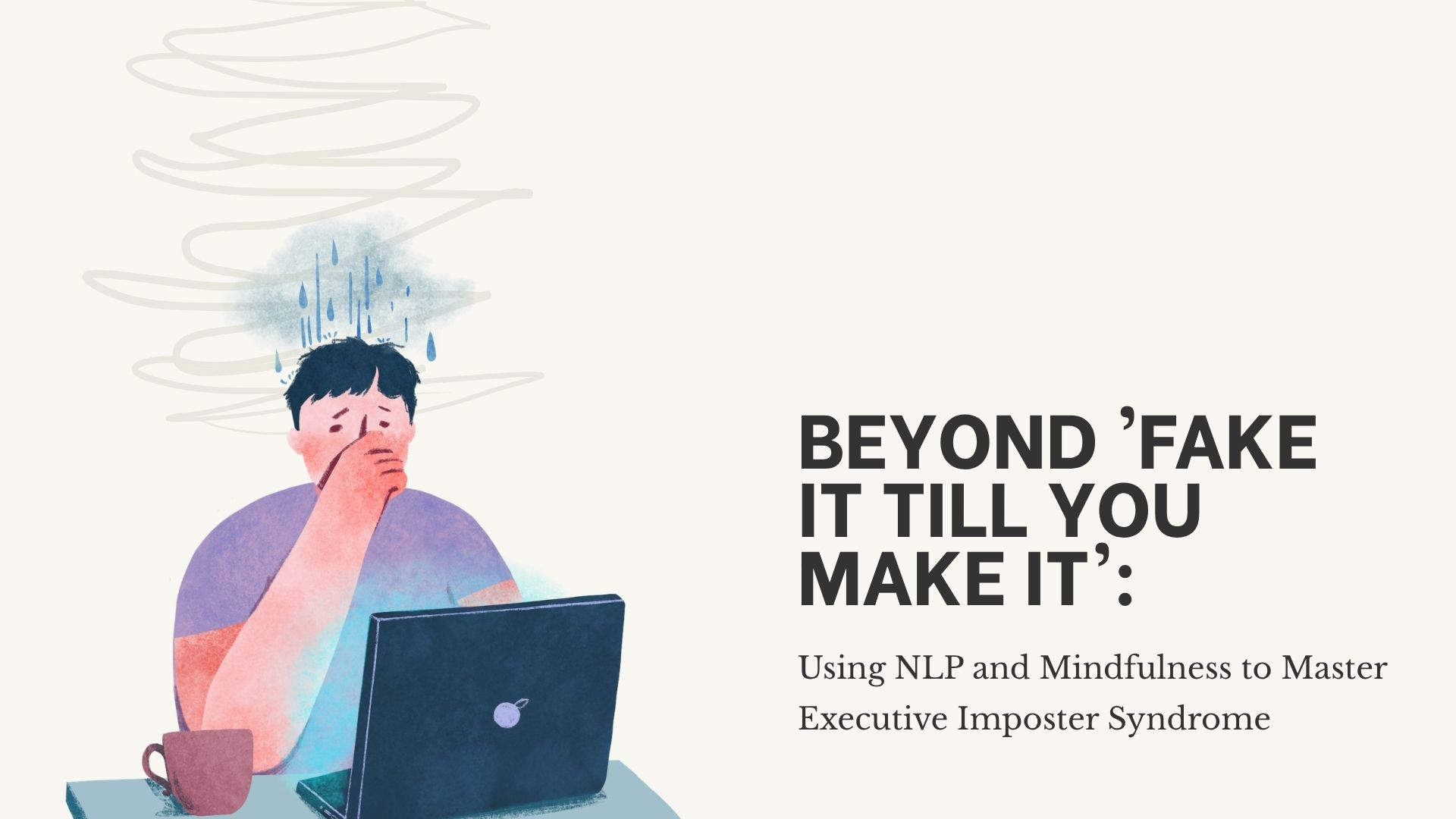
Stepping into a higher-level leadership role, managing larger teams, or pivoting your career trajectory often triggers a familiar, uncomfortable sensation: the persistent fear of being exposed as a fraud.
Even high achievers frequently attribute their success to luck, timing, or external circumstances rather than their own competence. This form of executive imposter syndrome creates decision paralysis, chronic overworking, and underlying anxiety.
Rather than relying on superficial advice like "fake it till you make it," you can address imposter syndrome at a cognitive and physiological level using Neuro-Linguistic Programming (NLP) and mindfulness techniques.
1. Dismantling Limiting Beliefs with the NLP Meta-Model
Imposter syndrome thrives on internal generalizations and cognitive distortions. The NLP Meta-Model helps you challenge and dismantle these automated, unhelpful thought patterns by asking precision questions.
* Challenge Distortions: When your mind says, "I just got lucky with that presentation," challenge the premise. Ask yourself: "What specific skills, preparation, and actions did I contribute that led to that outcome?" * Separate Fact from Feeling: Recognize that feeling unqualified is an emotional state, not an objective truth. Reframe internal language from "I don't know what I'm doing" to "I am in the process of mastering this new challenge."
2. Cultivating Mindful Self-Compassion Under Pressure
When high performers make mistakes, they often treat themselves far more harshly than they would ever treat a colleague. Mindful self-compassion interrupts this cycle, reducing the fear of failure that fuels imposter feelings.
* Somatic Grounding: When a surge of self-doubt hits during a key moment, anchor yourself in the present moment. Focus on your breathing or the physical sensation of sitting in your chair for 10–15 seconds to disarm the brain's threat response. * Non-Judgmental Awareness: Observe self-critical thoughts without accepting them as truth. Treat self-doubt as a temporary mental phenomenon rather than an accurate reflection of your capabilities.
3. Adopting a Growth Identity Mindset
Imposter syndrome stems from a fixed identity mindset—the belief that competence is static and that asking for help or making a mistake proves you don't belong.
* Shift to an Evolution Mindset: Leadership is not a state of perpetual expertise; it is a discipline of continuous adaptation. * Reframe the Narrative: View new responsibilities not as a test of your pre-existing worth, but as an environment designed to expand your capabilities.
Stepping into Your Authority
True confidence is not the absence of self-doubt; it is the ability to lead effectively in spite of it. By using NLP tools to challenge unhelpful mental narratives and mindfulness to manage the physiological response to stress, you can move past imposter syndrome and lead with authentic authority.